Build Your Own Dryland Workout: An Exercise Menu for Swimmers
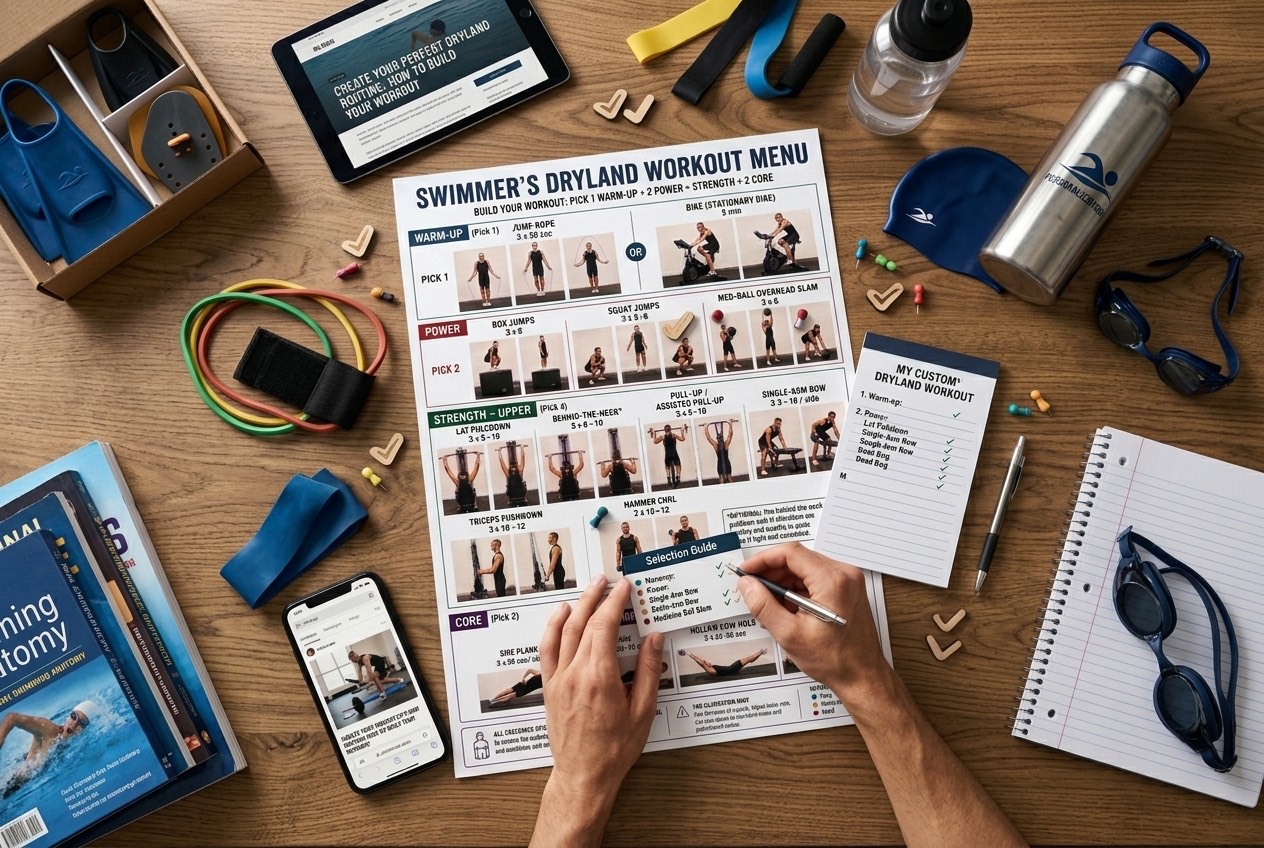
Most dryland plans prescribe the exact same session every time. This page works differently: it is an exercise menu, not a fixed workout. Pick a balanced subset depending on the day, how you feel, and what equipment is available. You get variety and autonomy without losing structure — and a complete session takes about 35–45 minutes.
BUILD YOUR WORKOUT — PICK 1 WARM-UP + 2 POWER + 4 STRENGTH + 2 CORE
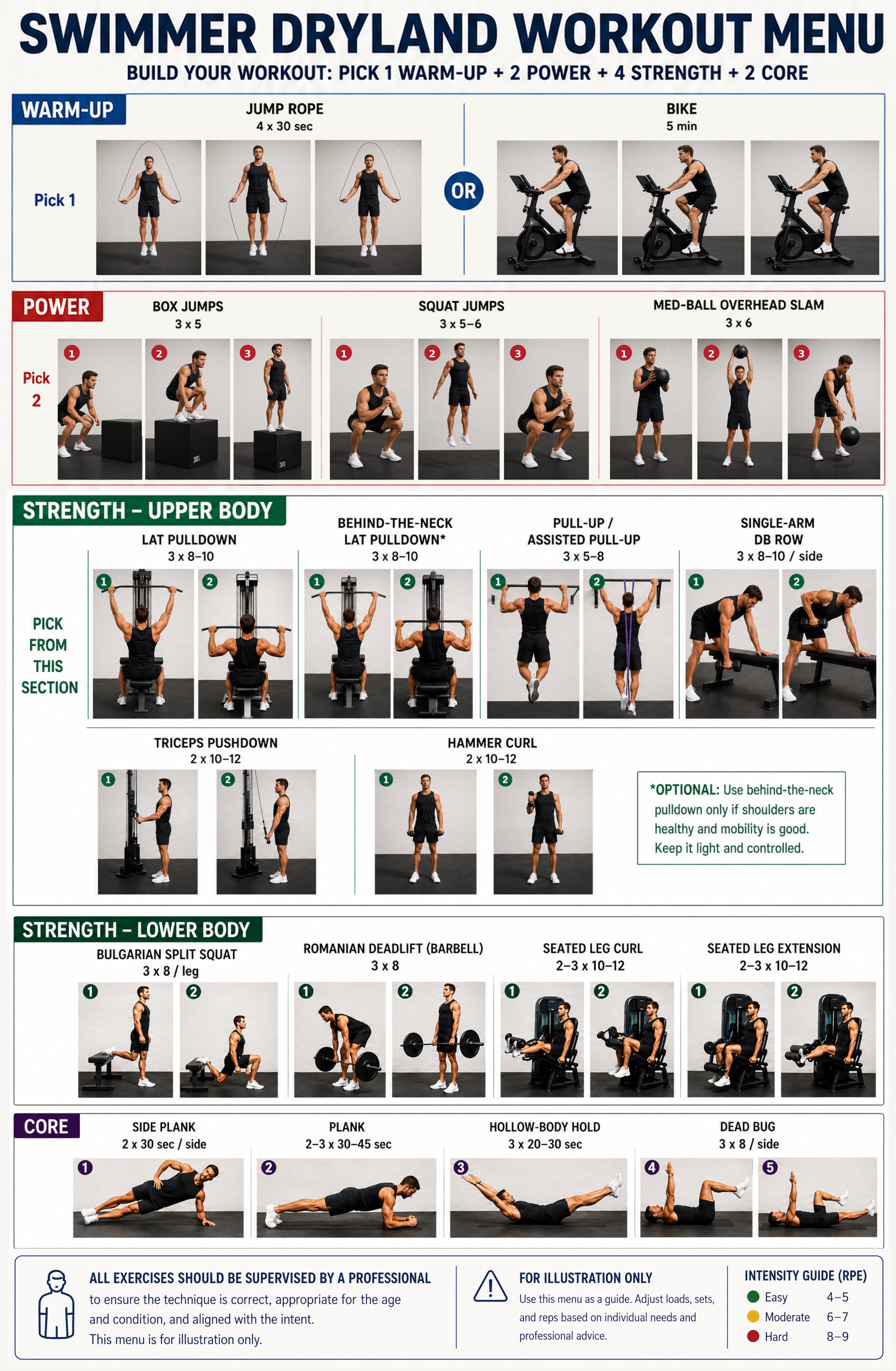
The pick rule keeps every session balanced: it stops you from accidentally building a workout with five pulling exercises and no legs. When choosing your 4 strength exercises, mix upper and lower body. New to dryland? Start with our article on why dryland training matters for swimmers.
Warm-up — pick 1
A warm-up raises your heart rate and core temperature, and prepares your joints and muscles to move fast. Going straight into jumps or heavy lifts with cold muscles is how injuries happen. Five minutes is enough.
| Exercise | Sets / reps | Why it helps |
|---|---|---|
| Jump rope | 4 × 30 sec | Wakes up ankles, calves, and coordination — great prep for jumping work. |
| Bike | 5 min | Easy full-body heart-rate raise with no impact. |
Power — pick 2
Power (explosive) work trains your muscles to produce force fast. In swimming, that is the start off the blocks, every turn, and the underwater push-off. Do these early in the session while you are fresh: quality and full effort matter more than quantity.
| Exercise | Sets / reps | Why it helps |
|---|---|---|
| Box jumps | 3 × 5 | Explosive leg drive — directly carries over to starts and turns. |
| Squat jumps | 3 × 5–6 | Same leg power with no equipment needed. |
| Med-ball overhead slam | 3 × 6 | Explosive pull from overhead through the core — the same path as a swim stroke. |
Strength — pick 4 (mix upper and lower)
Strength work builds the engine. A stronger pull moves more water per stroke, and stronger legs mean faster starts, turns, and a stronger kick. Because swimming is pull-dominant, the upper-body menu is built around pulling movements — pulldowns, pull-ups, and rows — which train the lats and upper back, the prime movers of every stroke.
Upper body
| Exercise | Sets / reps | Why it helps |
|---|---|---|
| Lat pulldown | 3 × 8–10 | The foundational pulling pattern — builds the lats that power your catch and pull. |
| Behind-the-neck lat pulldown* | 3 × 8–10 | An alternative to the regular pulldown, not an addition — see the note below. |
| Pull-up / band-assisted pull-up | 3 × 5–8 | One of the highest-value upper-body exercises on this menu — full-body pulling strength. Use an elastic band for assistance until you can do them unassisted. |
| Single-arm dumbbell row | 3 × 8–10/side | Trains each side independently, just like your stroke, and evens out imbalances. |
*The behind-the-neck pulldown requires good shoulder mobility. Keep it light and controlled, and treat it as a swap for the regular lat pulldown — do not select both in the same session.
Lower body
| Exercise | Sets / reps | Why it helps |
|---|---|---|
| Bulgarian split squat | 3 × 8/leg | Single-leg strength and balance — the position you drive from on every turn. |
| Barbell Romanian deadlift | 3 × 8 | Builds the hamstrings and glutes behind your kick and streamline. |
| Seated leg curl | 2–3 × 10–12 | Isolated hamstring work to balance out all the kicking. |
| Seated leg extension | 2–3 × 10–12 | Isolated quad strength for the down-kick and push-offs. |
Arms — optional finishers
Swimming already gives the biceps and triceps substantial work, and the pulldowns, pull-ups, and rows above train the arms indirectly. So keep direct arm work secondary: these two are optional extras to finish the session, not part of your “pick 4 strength”. If you enjoy them, they are a perfectly reasonable way to end.
| Exercise | Sets / reps | Why it helps |
|---|---|---|
| Triceps pushdown | 2 × 10–12 | Strengthens the finish of your stroke. |
| Dumbbell hammer curl | 2 × 10–12 | Balances the pulling work with simple biceps and forearm strength. |
Core — pick 2
The core connects your pull to your kick. A stable core holds your streamline, keeps your hips high in the water, and transfers power from arms to legs without energy leaking away as wobble. These are holds and controlled movements — quality of position beats duration.
| Exercise | Sets / reps | Why it helps |
|---|---|---|
| Plank | 2–3 × 30–45 sec | The classic streamline-position hold. |
| Side plank | 2 × 30 sec/side | Builds the lateral stability that controls body rotation in freestyle and backstroke. |
| Hollow-body hold | 3 × 20–30 sec | The closest gym exercise to an actual streamline — a swimmer favorite. |
| Dead bug | 3 × 8/side | Teaches you to move arms and legs while the trunk stays still — exactly what good swimming demands. |
A sample session
Here is what a typical day built from the menu looks like:
Jump rope → Box jumps → Med-ball slam → Pull-ups → Single-arm dumbbell row → Bulgarian split squat → Romanian deadlift → Hollow-body hold → Side plank
That is roughly 35–45 minutes and an excellent dryland session for a swimmer. Next time, swap in different choices from each section — that is the whole point of the menu.
Happy swimming!
- Tags:
- Dryland training
- Strength
Latest Posts
Setting Goals as a Swimmer: Why It Matters and How to Do It Right
September 7th 2026
The College Swimming League (CSL) Explained
September 5th 2026
USA Swimming Championships and Time Standards Explained
August 16th 2026
Essential Items to Pack in Your Swim Backpack for a Meet
October 2nd 2023
Swimming Time Standards: What You Need to Know
November 24th 2022
The Best Swim Gear for Optimal Performance
October 3rd 2022
The Importance of Dryland Training for Swimmers
September 28th 2022
Understand the heat sheets and what to write on the swimmer's arm for a meet
September 25th 2022