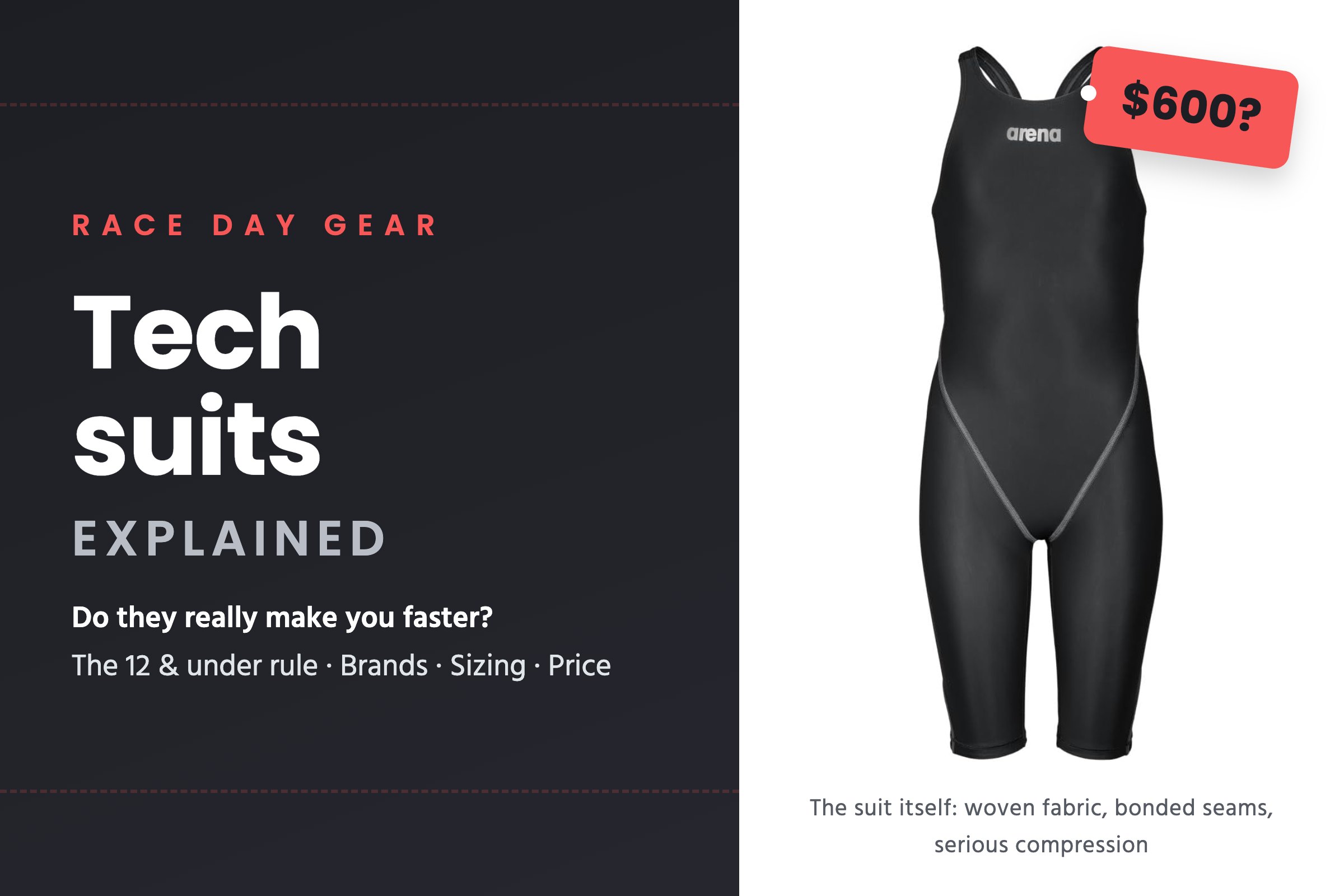
Tech Suits Explained: What They Do, When Your Swimmer Needs One, and How Not to Pay $600
Sooner or later it happens to every swim family. You are on the pool deck at a championship meet, half the team is squeezed into shiny suits that took twenty minutes to put on, and someone mentions what they paid for one. Three hundred dollars. Four hundred. Six hundred. For a swimsuit. Is it worth it? Does your swimmer need one? And why is the 10-year-old lane mate not allowed to wear one? Here is the whole story, with the marketing stripped out.
What exactly is a tech suit?
A technical racing suit — a tech suit — is a competition suit engineered to reduce drag. Three things separate it from the suit your swimmer trains in every day:
- Woven, water-repellent fabric. Training suits are knit and soak up water. Tech suit fabric is woven tight and coated to repel it, so the suit stays light and smooth in the water.
- Bonded seams. Instead of stitching, the panels are glued or taped together, leaving no raised seam for water to catch on.
- Compression. The suit squeezes the body into a smoother, more streamlined shape and supports the muscles. This is also why it is so hard to put on — more on that below.
Boys wear jammers (waist to knee), girls wear kneeskins (shoulders to knee, in open-back or closed-back cuts). Every legal racing suit is textile: after the 2008–2009 “super suit” era, when polyurethane bodysuits rewrote the record books, non-textile suits were banned from 2010. Suits approved for competition carry a World Aquatics (FINA) approval logo.
Do you really swim faster in one?
Yes — but by less than the price tag suggests, and the honest range is wide. Published research has found performance improvements from about 0.3% up to about 3.2%, with drag reduced by roughly 4–6% and the energy cost of swimming cut by a similar amount in the favorable studies. A famous Indiana University analysis put the real-world effect at the low end of that range.
What does that mean in actual time? Take a swimmer who goes 1:00.00 in the 100 free. A 1% improvement is 0.6 seconds — often the gap between a time standard made and missed. That is why you see tech suits at championship meets. It is also why a tech suit is pointless at a regular dual meet: it does not replace training, taper or technique, it just puts a small bow on top of them.
There is a second effect, though, and it may be the bigger one: confidence. Putting on a tech suit tells a swimmer, in the most physical way possible, “today is the day you go fast.” They stand on the blocks feeling sleek, locked in and taken seriously — and a swimmer who believes they are about to swim fast races differently: they attack the start, hold their stroke together, and fight the last 15 meters. The fabric may only buy a few tenths on its own, but the mindset it switches on can be worth far more than the physics. That is not a reason to buy a $600 suit for a 10-year-old — it is a reason the suit works best when it is saved for the meets that matter, so putting it on keeps meaning something.
The rule every parent should know: 12 & unders can't wear them
Since September 1, 2020, USA Swimming bans swimmers aged 12 and under from wearing tech suits at every sanctioned, approved or observed meet in the United States. The official definition is any suit with bonded or taped seams, or woven fabric extending past the hips — regardless of brand or price.
How to know what a 12-and-under can wear: suits that comply carry a special green checkmark logo, and anything without a World Aquatics/FINA approval logo is fine by definition. SwimOutlet maintains a good breakdown of the rule and the compliant suits. (There are exceptions at a handful of elite meets — Junior Nationals, US Open, Nationals, Olympic Trials — that do not concern a typical age-group season.)
The practical takeaway: a first tech suit makes sense around age 13, for a championship meet. Before that, a well-fitting regular racing suit is both the legal and the sensible choice — at that age, time drops come from growth and training, not fabric.
The brands and models, decoded
Arena is the suit “everyone” seems to have on deck, but it is not objectively the best — at the same tier, the big brands are all fast, and independent testers shuffle their rankings every year. What actually differs is the fit and the feel of the compression. Two things to know before reading any price: within one brand, the models mostly differ in how much compression they apply (more lockdown = flagship price, harder to put on), and girls' kneeskins cost $150–250 more than boys' jammers for the same model, simply because there is far more engineered fabric.
List prices below are as shown on each brand's own US online store in early October 2026 (solid colors — printed versions cost more). Nearly everything was also on sale somewhere, which tells you how negotiable these numbers are.
Arena (arenasport.com)
Arena's range is really one ladder of compression. Every step up grips the body harder, costs more, and takes longer to put on. The fabric and seams change at two break points: entry suits are knitted with stitched seams, the mid-tier moves to woven fabric, and the elite suits add bonded seams.
Knitted fabric, stitched seams. A first racing suit — and the only one on this ladder a 12-and-under is allowed to race in.
Woven fabric, still stitched seams. Real racing-suit feel, in junior sizes too, without the elite price.
Woven fabric, bonded seams. The gentlest elite suit: easiest to put on, comfortable for a whole session — the club favorite.
The Air, one generation newer: the same light “second skin” feel with updated fabric.
The newest speed suit: a firmer hold than the Airs without the full Primo squeeze.
Maximum compression — the flagship Arena’s Olympians race in.
Compression levels are Arena's own 1–5 ratings. One model is missing from this ladder: the Carbon Core FX ($550 list), the old maximum-lockdown sprint suit, now on deep clearance as the Carbon line winds down — a bargain if your swimmer likes a very tight suit.
So when a teammate says “she races in Arena,” that can mean anything from a $155 junior Impulso to a $650 Primo. The practical ladder: ST Next or Impulso for the first suited meet, Carbon Air² or Air 3 once championship meets are routine, Primo or Veloce when tenths genuinely decide the outcome.
Speedo (us.speedo.com)
| Model | Jammer | Kneeskin | What it is |
|---|---|---|---|
| LZR Pure Intent 2.0 | $454 | $674 | The flagship: dual-fabric construction and the most compression Speedo makes. Printed versions run up to $764. |
| LZR Pure Valor 2.0 | $424 | $574 | Same platform, lighter and more flexible — aimed at swimmers who find the Intent's lockdown too much. |
| Fastskin HyperSpark | $122 | — | The entry point into the Fastskin family for younger racers. |
Mizuno (usa.mizuno.com)
Mizuno prices all three GX-Sonic 6 variants at $410 (men's) and differentiates purely by feel: the NV is the stiffest, maximum-compression sprint suit — the cult favorite among 50/100 specialists; the CR trades a little lockdown for freer movement; the ET is the softest and most flexible of the three. The day we checked, all of them were marked down to $300 — flagship-level technology at a mid-tier price, if the aggressive fit suits your swimmer.
TYR (tyr.com)
| Model | Jammer | Kneeskin | What it is |
|---|---|---|---|
| Venzo | $450 | $650 | The flagship — the suit TYR's international medalists race in, Katie Ledecky's signature editions included. |
| Avictor | $375 | $550 | The previous flagship, still sold — proven technology one notch down in price. |
If you can, have your swimmer try teammates' brands for fit before buying: a well-fitting mid-tier suit beats a badly-fitting flagship every time.
How to pay (much) less
The single best trick: never buy a tech suit the week you need it. That is how you end up paying full retail for the one size left in stock. Instead:
- Buy last season's model. When a new flagship ships, the previous generation drops 30–50% and is nearly identical. The “old” Carbon Air² made plenty of cuts.
- Shop the off-season sales. Retailers like SwimOutlet and Elsmore run aggressive promotions around holidays and between championship seasons — exactly when nobody is suit-shopping.
- Pick the unpopular color. The same suit in last year's colorway is routinely discounted.
- Ask about a team discount. Many clubs have a deal with a brand or a local shop.
How real are these discounts? The day we collected the prices above, Mizuno's $410 flagships were marked down to $300, TYR was running a 30%-off sitewide flash sale, and Arena's Carbon Core FX was close to half price. Full retail is what you pay for waiting until taper week. Buy the suit when the deal appears, in the size that fits now — then leave it in the bag until championship weekend.
Why is it so hard to put on? (It's supposed to be.)
Plan on 10 to 20 minutes the first time. The compression that makes the suit fast makes it a workout to wear, and there is real technique to it:
- Put it on completely dry — dry skin, dry suit, never over a wet body if you can avoid it.
- Work from the ankles up in small folds, rolling the fabric rather than yanking it.
- Fingertips, never fingernails. A nail through a $400 suit is a rite of passage nobody enjoys. Some swimmers wear thin gloves.
- Get it fully seated at the hips and shoulders before judging the fit.
And treat it gently afterwards: rinse in cold water, drip dry away from the sun, never machine-wash, never wring, and keep it out of hot tubs — heat and chlorine destroy the water-repellent coating. Even cared-for, a tech suit holds its peak for roughly 10–15 race sessions. That is one more reason it should never see a regular practice.
Which size should you buy?
Not the training-suit size. Use the brand's own size chart against your swimmer's measurements, and expect the right size to feel uncomfortably snug standing on deck. The working rules:
- If it slides on in two minutes, it is too big — and a loose tech suit is just an expensive regular suit.
- If it cuts circulation, pinches the shoulders, or prevents a full streamline, it is too small. Snug yes, numb no.
- Between sizes? For a growing age-grouper, take the larger one. And buy for the body your swimmer has now — a tech suit is not something to grow into.
- Girls: try both open-back (more shoulder freedom) and closed-back (more compression) cuts before deciding.
Did it actually help? Check the data
Here is the fun part. After the meet, open your swimmer's ScoreMeUp profile and look at the progression chart for the events they raced suited. You will usually see the championship-meet drop clearly — and you can judge how much of it was the taper, the training block, and yes, maybe a few tenths from the suit. For the rest of the gear bag, from goggles to backpacks, we keep our favorites on the apparel & gear page.
Happy swimming!
- Tags:
- Gear
- Tech suits
- Swim parents
Latest Posts

Setting Goals as a Swimmer: Why It Matters and How to Do It Right
September 7th 2026
The College Swimming League (CSL) Explained
September 5th 2026
USA Swimming Championships and Time Standards Explained
August 16th 2026
Build Your Own Dryland Workout: An Exercise Menu for Swimmers
August 15th 2026
Essential Items to Pack in Your Swim Backpack for a Meet
October 2nd 2023
Swimming Time Standards: What You Need to Know
November 24th 2022
The Best Swim Gear for Optimal Performance
October 3rd 2022
The Importance of Dryland Training for Swimmers
September 28th 2022
Understand the heat sheets and what to write on the swimmer's arm for a meet
September 25th 2022